
October 23, 2025, Washington, D.C.
In a significant change in tone and approach, U.S. President Donald Trump voiced his displeasure with his continued conversations with Russian President Vladimir Putin, claiming that they “don’t go anywhere.” The comments coincided with Trump’s announcement of a comprehensive new set of economic penalties aimed at Russia’s banking and energy industries, marking the most forceful American reaction to Moscow’s ongoing military incursion in Ukraine to yet.
The declaration, which combines severe rhetoric with real financial pressure, is a turning point in U.S.-Russian relations. In his dealings with Putin, Trump, who has long praised his ability to “get along” with international leaders, suddenly seems to be realizing the limitations of diplomacy.
An Unexpected Change in Policy
Citing a lack of progress in peace talks, President Trump said at a White House press briefing that he has canceled a planned summit with Putin in Budapest.
“Every time I speak with Vladimir, I have good conversations,” Trump told reporters. “But they just don’t go anywhere. There’s a point where you stop talking and start acting — and that’s what we’re doing now.”
The president announced that in addition to more limitations on state-owned banks and technology exporters associated with the defense sector, his government will impose fresh sanctions on Russia’s two biggest oil companies, Rosneft and Lukoil. The sanctions essentially prevent access to Western funding, limit the export of technology manufactured in the United States, and freeze assets located in the United States that are connected to sanctioned people and businesses.
According to senior administration officials, the measures are designed to “cripple Russia’s energy revenues,” which continue to fund its war operations in Ukraine.
What Caused the Motion
Trump’s declaration comes after months of diplomatic deadlock. The White House claims that Moscow has demonstrated “no meaningful commitment” to stopping its military operations or holding meaningful peace talks, despite many phone conversations and indirect discussions through middlemen.
According to reports, the last straw occurred during a recent backchannel conversation between Russian and American officials in Geneva, where Kremlin delegates restated demands that Washington considered “unacceptable.”
On background, a senior U.S. official stated, “We’ve tried patience and we’ve tried dialogue.” The President has come to the conclusion that Putin’s plan is to continue his offensive while stalling. The purpose of these penalties is to alter that computation.
Specifics of the Sanctions
Several sectors of the Russian economy are the focus of the most recent set of U.S. sanctions:
Energy Sector: Due to limitations, Rosneft and Lukoil are unable to access Western financial systems. If their tankers and businesses keep shipping oil to countries that are breaking the price cap on Russian petroleum, they may also be subject to secondary sanctions.
Banking and Finance: The inability of a number of significant Russian banks, such as VTB and Gazprombank, to handle transactions in US dollars has limited their capacity to engage in international trade.
Technology and Defense: Twenty-five further Russian defense and technology companies have been placed on a blacklist, preventing them from accessing US software, microchips, and high-tech parts.
Individual Sanctions: Important Kremlin officials and oligarchs are subject to the sanctions, including those who are said to have helped obtain weapons or to have made it easier for sanctions to be avoided in the past.
At a time when its economy is already struggling as a result of previous Western actions, these actions are predicted to further isolate Russia financially.
Trump’s Approach: From Discussion to Conflict
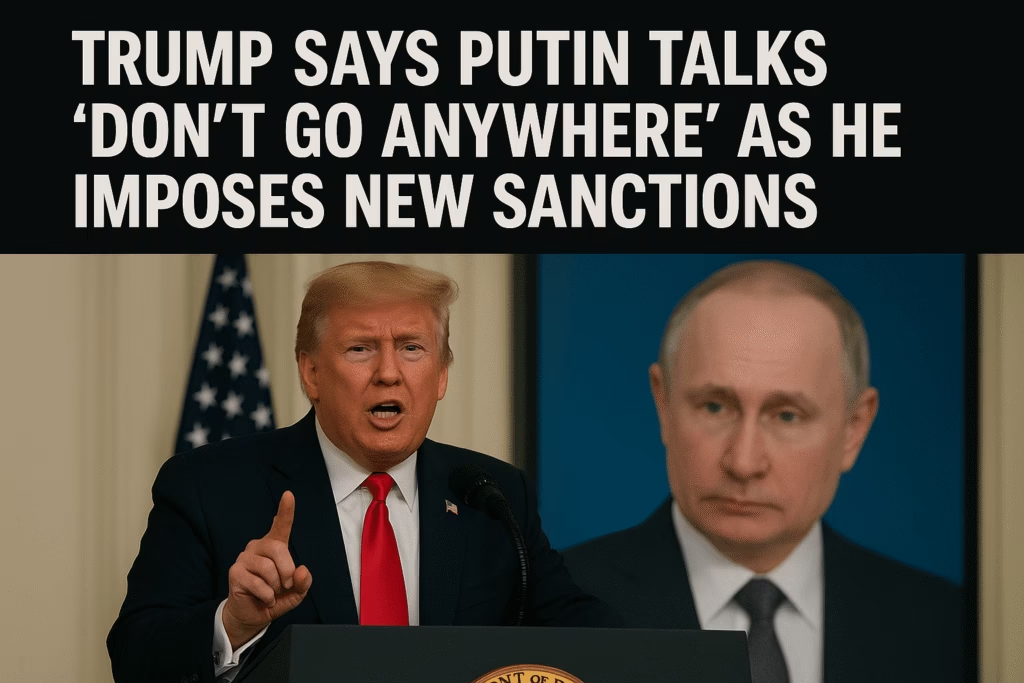
Trump’s remarks during his speech marked a significant shift from his previous diplomatic endeavors.
The president had been highlighting the possibility of a “deal” with Putin for months, implying that the two leaders may come to an agreement. On Thursday, however, his tone was very different: tired, firm, and very transactional.
“We’ve talked enough,” Trump declared. “I dislike wasting time. You move on when folks fail to deliver. That is the role of leaders.
The President’s comments, according to observers, show that the White House no longer thinks diplomacy is enough to get Russia to the bargaining table. Washington currently seems to be depending more on economic leverage, which is a tactic that is more in line with the EU’s present agenda.
International Responses
Europe
In a matter of hours, the European Union announced its 19th round of penalties against Moscow, promptly applauding the U.S. move. The EU’s actions target maritime firms that assist in circumventing current trade restrictions as well as Russian liquefied natural gas (LNG) exports.
Ursula von der Leyen, president of the European Commission, said in a statement,
“There has never been a stronger transatlantic bond. By working together, we are making sure that Russia’s war machine is subject to constant and calculated economic pressure.
Russia
The initial response from Moscow was unsurprisingly defiant. Trump’s remarks were deemed “unconstructive” by a Kremlin official, who also charged Washington with attempting to “undermine Russia’s sovereignty.”
Sergey Lavrov, the Russian foreign minister, described the penalties as “illegal and hostile acts” and stated that they would not change the Kremlin’s position. Analysts did observe, however, a rare expression of worry in Russian official media, which cautioned about potential short-term interruptions to oil exports and the stability of the currency.
India and China
Beijing denounced the sanctions as “unilateral coercive measures,” while India cautioned that both parties should continue to communicate diplomatically to prevent more disruptions to the world economy.
Effect on World Energy Markets
Oil markets have already been shook by the latest penalties. Within hours after Trump’s statement, Brent crude prices jumped beyond $96 per barrel due to concerns about supply constraints.
Tighter sanctions on Russia, according to energy experts, could put pressure on global supply chains, especially in Europe and Asia, where Russian oil is still vital despite previous prohibitions.
“These sanctions may have repercussions that extend well beyond Russia,” stated Sarah McAllister, an Atlantic Council energy specialist. “They put more pressure on Moscow, but they also run the risk of raising global energy prices, which could have an impact on domestic politics in the United States and Europe.”
However, U.S. officials contend that if it forces Moscow to change its direction, the possible expense is acceptable.
Ukraine’s Reaction
Volodymyr Zelensky, the president of Ukraine, hailed Trump’s action in Kyiv, referring to it as “a decisive step toward justice.”
In a televised speech, Zelensky stated, “We value the United States’ leadership and President Trump’s dedication to holding Russia accountable.” “Until Russian forces completely evacuate Ukrainian territory, this pressure must continue.”
Zelensky also called on other Western allies to “close any remaining loopholes” that permit Russian exports to finance the conflict and to follow Washington’s sanctions.
U.S. domestic political reactions.
Bipartisan backing for Trump’s move was unusual on Capitol Hill.
Democratic Senator Chris Murphy referred to the action as “long overdue,” while Republican Senator Lindsey Graham said it “shows strength and clarity.”
Ahead of the 2026 midterm elections, several Trump detractors warned that the economic fallout, especially the growing cost of petrol, could turn into a domestic political liability.
Senator Rand Paul, who has previously questioned sweeping sanctions policy, stated that while the American people favor firmness, they also want stability at the pump.
The Path Ahead
Trump stressed that communication is still an option, but only if Moscow shows a “real willingness” to work toward peace, despite his frustration.
“We’re not going to stop talking forever,” he stated. “However, they must be genuine, productive, and capable of taking the initiative.”
A strategic caution, according to analysts, is that Russia may still talk its way out of isolation, but only if it ceases using diplomacy as a means of delay.
The sanctions package, meanwhile, marks the biggest intensification of Washington-Moscow economic battle since the start of the invasion.
A Watershed in U.S.-Russian Relations
Trump’s statement that “Putin talks don’t go anywhere” captures the mounting frustration of Americans with years of fruitless negotiations. The latest penalties imply that Washington is switching from persuasion to coercion, using the hammer in place of the handshake.
It remains to be seen if this tactic pushes Moscow to the negotiating table or encourages more conflict. However, there is no denying that the U.S.-Russian relationship has entered one of its most turbulent periods in decades, with long-term repercussions on international energy markets, diplomacy, and the economy.